

Your comprehensive founder’s roadmap: from market validation to tech architecture, AI integration, and scaling with a dedicated team. Build your SaaS vision the right way.

Is the fear of building a product no one will use keeping you up at night? The dream of a successful SaaS company can quickly become a source of anxiety when you’re faced with a mountain of technical choices and the looming question of AI integration, with potential initial costs easily reaching tens of thousands of euros. These challenges are real, but they are not insurmountable. The landscape for how to build a SaaS product is rapidly changing, and the old playbooks are no longer sufficient for the competitive Finnish and global markets of 2026.
Consider this your comprehensive founder’s roadmap, designed to cut through the noise and transform your uncertainty into a clear, actionable strategy. We will guide you step-by-step through the entire journey: from initial market validation that guarantees demand, to choosing the right technical architecture for future growth. You will gain the confidence to integrate AI meaningfully and cost-effectively, and learn precisely how to scale your team for sustainable success. Let’s build your vision, the right way.
Key Takeaways
- Prioritize deep market validation to solve a genuine customer problem; this is the foundation of a successful SaaS, shifting focus from features to solutions.
- Learn how to choose a future-proof tech stack and navigate a structured development lifecycle to build a resilient and secure multi-tenant architecture.
- Discover how to build a SaaS product that leverages AI for more than just support, creating predictive experiences that boost user retention and efficiency.
- Understand the critical inflection point for scaling and why partnering with a dedicated development squad can be your key to sustainable growth and technical excellence.
Defining Your SaaS Vision: Market Validation in the 2026 Economy
Before a single line of code is written or thousands of Swiss Francs are invested, the foundation of a successful SaaS platform is laid in understanding, not building. The journey of Software as a Service (SaaS) has evolved beyond a simple delivery model; it is a commitment to providing continuous, evolving value. In today’s market, the focus has shifted decisively away from “feature-rich” products toward elegant solutions that solve a single, deeply felt “Core Pain.” Answering this need is the first step in learning how to build a saas product that endures. The most critical question is not “what can we build?” but “what recurring problem are users willing to pay to solve?”
The 2026 SaaS Landscape: Trends and Expectations
Looking toward 2026, the SaaS market is maturing. We see a definitive shift towards vertical SaaS-hyper-specialized tools for niche industries, from Geneva’s wealth management sector to Basel’s pharmaceutical research. User expectations have also peaked; a seamless, high-performance experience across all devices is the baseline, not a luxury. This new standard is often influenced by the “Helsinki approach” to software, which prioritizes robust quality, minimalist design, and unwavering user trust-principles that resonate deeply within the Swiss market.
Validating Your Idea Without Building a Full Product
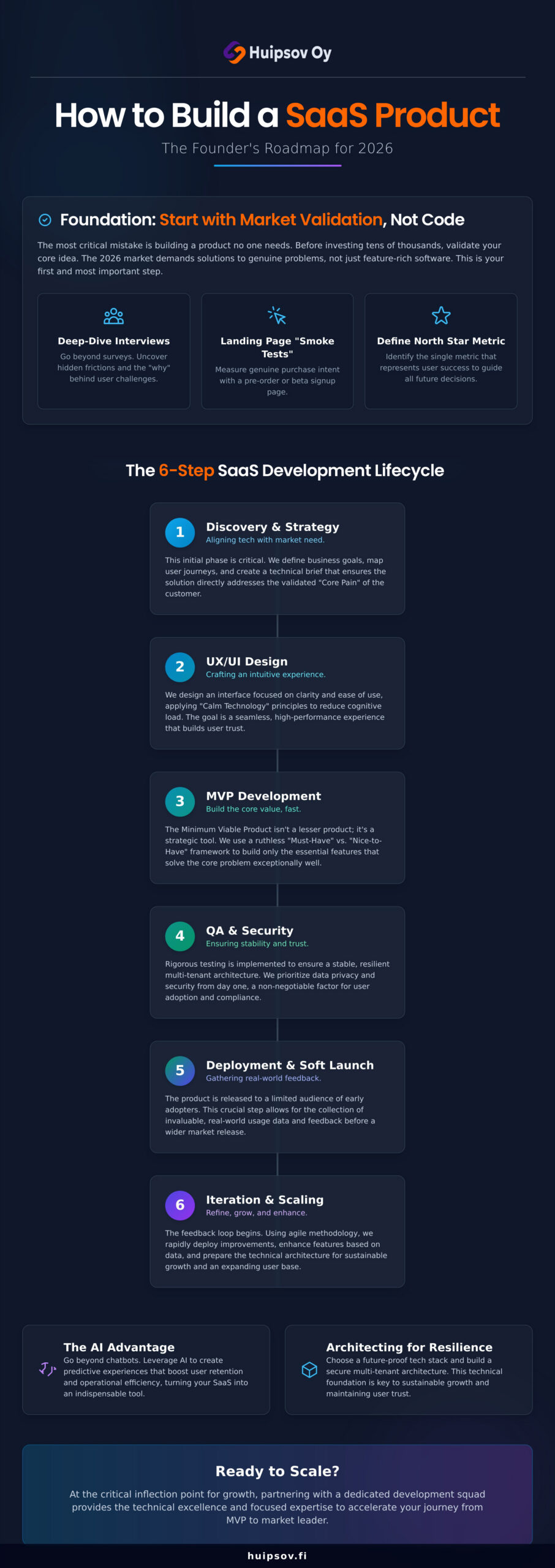
Validating your vision doesn’t require a finished product or significant capital. It requires a strategic, lean approach to test your core hypothesis: will people pay for this solution? Here are three essential steps:
- Conduct Deep-Dive User Interviews: Go beyond surveys. Sit down with potential customers and listen to uncover the hidden frictions and emotional drivers behind their challenges. What manual workarounds are they currently using?
- Use Landing Page “Smoke Tests”: Create a simple webpage that clearly explains your value proposition. Include a call-to-action like “Pre-order for an early-adopter price of CHF 20” or “Join the Private Beta.” This measures genuine purchase intent, not just casual interest.
- Define Your North Star Metric: Before development, identify the single metric that best represents user success. For a project management tool, it might be “tasks completed per week.” This metric will guide every future product decision with clarity and purpose.
The SaaS Development Lifecycle: A 6-Step Engineering Roadmap
Understanding how to build a SaaS product that lasts requires a structured, yet flexible, engineering roadmap. This journey from concept to a scalable platform is not a single sprint but a carefully managed lifecycle. A disciplined approach ensures you invest resources wisely and validate your assumptions at every turn. We break it down into six core phases:
- Phase 1: Discovery & Strategy: Aligning your technical build with a clear market need and business goals.
- Phase 2: UX/UI Design: Crafting an intuitive interface, often guided by “Calm Technology” principles to reduce cognitive load and enhance user focus.
- Phase 3: MVP Development: Building the essential, core version of your product to solve one problem exceptionally well.
- Phase 4: Quality Assurance & Security: Implementing rigorous testing to ensure stability and protect user data, a critical factor in the Swiss market where data privacy is paramount.
- Phase 5: Deployment & Soft Launch: Releasing the product to a limited audience to gather initial, real-world feedback.
- Phase 6: Iteration & Scaling: Using that feedback to refine the product and prepare for wider market growth.
From Idea to MVP: Prioritizing the Core Value
The MVP (Minimum Viable Product) stage is where your idea becomes tangible, and it’s a critical step in learning how to build a SaaS product efficiently. The key is ruthless prioritization. Use a “Must-Have” vs. “Nice-to-Have” framework to focus engineering efforts solely on the core value proposition. An MVP is not a lesser product; it’s a strategic tool for learning and validating your core hypothesis with minimal investment. It’s a process, not a destination. To accelerate this phase, many Swiss startups partner with focused agencies; for example, specialists in MVP development Helsinki can bring dedicated expertise to shorten your time-to-market.
Iterative Development and the Feedback Loop
Once your MVP is live, the real work of refinement begins. Adopting an agile methodology with structured sprints allows your team to deploy improvements rapidly and consistently. This creates a powerful feedback loop where you can collect user insights-through in-app surveys, analytics, and direct interviews-and translate them into a prioritized backlog. This iterative cycle is the engine of a successful product-led growth model. While speed is essential, maintaining high code quality through automated testing and peer reviews prevents “technical debt” from derailing future scalability.
Architecting for Resilience: Tech Stacks and Multi-Tenant Security
The technical foundation you choose will dictate your product’s future performance, cost, and ability to scale. A core decision in learning how to build a saas product is architecting for multi-tenancy from day one. This model, where a single instance of your software serves multiple customers (tenants), is the backbone of SaaS efficiency. However, it requires a robust, secure, and resilient infrastructure to ensure each tenant’s data is completely isolated and protected.
Your architecture must be built not just for today’s features but for tomorrow’s growth. This involves carefully selecting a technology stack, planning for infrastructure management, and embedding security and compliance into every layer of your platform.
The Modern SaaS Tech Stack
Choosing a tech stack is a balancing act between developer availability in Switzerland, long-term scalability, and speed of development. While trends shift, a few proven technologies consistently deliver the performance modern SaaS applications require.
- Frontend: For dynamic user interfaces, React offers a vast ecosystem and component-based flexibility. However, Next.js (a React framework) is often preferred for its superior performance, server-side rendering (SSR), and built-in SEO advantages.
- Backend: Node.js remains a top choice for its speed in handling I/O-intensive operations and its unified JavaScript language across the stack. Python, with frameworks like Django or FastAPI, excels in data-heavy applications and enables rapid development.
- Database: The choice between SQL and NoSQL depends entirely on your data structure. PostgreSQL (SQL) provides data integrity and is ideal for complex, structured data. In contrast, MongoDB (NoSQL) offers greater flexibility for evolving or unstructured data schemas.
Scalability and Infrastructure Management
A scalable architecture relies on modern cloud-native principles to handle fluctuating user demand without manual intervention. This ensures reliability and helps manage operational costs effectively.
- Cloud Providers: Leverage leading platforms like AWS, Google Cloud, or Microsoft Azure. Critically, all three have data centres in Switzerland, which is essential for addressing data sovereignty and FADP compliance.
- Containerization: Use Docker to package your application and its dependencies into portable containers. Then, orchestrate them with Kubernetes to automate deployment, scaling, and management seamlessly.
- Security and Compliance: Protecting user data is non-negotiable. Implement a “Security by Design” approach, where security is a core requirement, not an add-on. For Swiss and EU markets, building your platform to be compliant with Switzerland’s Federal Act on Data Protection (FADP) and GDPR is a critical feature that builds trust and unlocks market access.
The AI Advantage: Enhancing User Experience and Operational Efficiency
In today’s competitive landscape, integrating Artificial Intelligence is no longer an afterthought; it’s a foundational element for creating a market-leading platform. The conversation has moved beyond simple chatbots to building “Predictive SaaS”-intelligent systems that anticipate user needs, automate complex tasks, and deliver deeply personalized value. This proactive approach is a critical differentiator when determining how to build a SaaS product that not only attracts users but retains them for the long term.
True AI integration automates multi-step workflows, significantly reducing user friction and churn. Imagine a financial analytics tool that doesn’t just display data but automatically identifies anomalies and suggests corrective actions. By leveraging Machine Learning (ML), your platform can offer personalized data insights and reports that feel custom-made for each user. However, this power comes with responsibility. Embracing Ethical AI by ensuring transparency in automated decisions is paramount for building and maintaining user trust.
Practical AI Integration for Startups
For startups, the key is to start smart. Identify “low-hanging fruit” like intelligent search, automated data tagging, or smart content recommendations. You’ll face the “build vs. buy” dilemma: developing a custom model is powerful but can cost upwards of CHF 50,000, while leveraging powerful LLM APIs offers a faster path to market. Finding the right partner is crucial; whether you seek local Swiss expertise or specialized teams like these providers of AI integration services Finland, expert guidance accelerates development.
Operational AI: Scaling Your Own Team
AI’s benefits extend beyond the user interface; they are essential for scaling your internal operations efficiently. Key areas for impact include:
- Development & QA: AI-powered tools can accelerate coding, automate test case generation, and identify bugs faster, shortening release cycles.
- Customer Support: Leverage AI to triage support tickets, provide instant answers from your knowledge base, and automate parts of the user onboarding process.
- Churn Prediction: Use AI-driven analytics to analyze user behavior, identify patterns that precede churn, and proactively engage at-risk customers with targeted support.
Scaling with Precision: Why a Helsinki-Based Partner Makes the Difference
You’ve navigated the initial stages of validating your idea and building an MVP. Now, the critical question shifts from how to build a saas product to how to scale it sustainably. As your user base grows, so does the technical complexity. This is the moment where moving from a solo founder or a small team to a dedicated development squad becomes essential for survival and growth. A Helsinki-based partner offers a unique blend of technical excellence, trust, and transparency-qualities that resonate deeply within the Swiss market.
This “Helsinki Quality” is built on a foundation of pragmatic problem-solving and a deep-seated commitment to engineering integrity. It’s about building a long-term roadmap that goes beyond the initial launch, covering crucial post-launch maintenance, security, and continuous feature evolution. The right partner provides the flexibility startups need to adapt and thrive. With a service like Staff Augmentation Finland, you gain access to a world-class talent pool precisely when you need it, without the long-term overhead of a large in-house team.
Building Your Technical Capacity
Deciding between hiring in-house or engaging a dedicated team is a pivotal choice. A hybrid model often provides the perfect balance for rapid scaling. By keeping your core product and business leadership in Switzerland, you can augment your team with a dedicated Finnish squad. This ensures deep cultural and technical alignment, creating a single, cohesive unit driven by shared values of precision and quality, allowing you to accelerate development while maintaining control over your vision.
The Huipsov Approach to SaaS Excellence
Our philosophy is rooted in empathetic engineering and scientific precision. We understand that behind every line of code is a human need and a business goal. We act as a bridge between world-class Finnish innovation and global markets, helping Swiss startups build robust, scalable platforms ready for international success. Your vision deserves a technical partner who not only understands the code but also the ambition behind it. Start your journey with a partner who is committed to building your future, one precise step at a time.
From Blueprint to Breakthrough: Your SaaS Journey Awaits
Building a successful SaaS product in 2026 is an exercise in strategic execution. As we’ve explored, your success hinges not on a single idea, but on rigorous market validation, a resilient technical architecture, and the intelligent integration of AI to create genuine user value. This comprehensive roadmap for how to build a saas product highlights a critical truth: the right technical partner transforms complexity into your greatest competitive advantage.
Navigating this path requires more than just code; it demands a partnership founded on precision and unwavering trust. At Huipsov, our Helsinki-based specialists are dedicated to turning ambitious concepts into market-ready MVPs. We combine deep expertise in AI development with a steadfast commitment to Finnish quality and transparency, ensuring your vision is built on a foundation engineered for scale and security.
Ready to build your SaaS? Let’s craft your MVP with Helsinki’s finest engineers. Your breakthrough product is within reach.
Frequently Asked Questions About Building a SaaS Product
How much does it cost to build a SaaS product in 2026?
In Switzerland, the initial cost for a Minimum Viable Product (MVP) typically ranges from CHF 70,000 to CHF 150,000, with projections for 2026 remaining similar. This estimate depends heavily on the product’s complexity, the size of the development team, and the specific features required. A simple application with core functionalities will be at the lower end, while a platform with advanced integrations, AI features, or stringent security requirements will command a higher budget.
How long does it typically take to launch a SaaS MVP?
Launching a well-defined SaaS MVP generally takes between four and nine months. This timeline is influenced by the complexity of your core features, the efficiency of your development process, and the size of your team. A focused approach, concentrating only on essential functionalities that solve a key user problem, is crucial for a timely launch. Rushing this foundational stage can lead to technical debt, so a balanced, deliberate pace is recommended for long-term stability.
Which is better for SaaS: Single-tenant or Multi-tenant architecture?
For most SaaS startups, a multi-tenant architecture is the superior choice. It allows multiple customers to use a single instance of the software, which significantly reduces infrastructure and maintenance costs, making it highly scalable. Single-tenancy, where each customer has their own dedicated software instance, offers greater security and customisation but is more expensive. It is typically reserved for large enterprise clients with specific compliance or data isolation requirements.
Do I need a technical co-founder to build a SaaS product?
While not an absolute requirement, having a technical co-founder is highly advantageous for navigating the complexities of product development and making informed technology decisions. If you don’t have one, alternatives include hiring a senior technical lead or partnering with a reputable Swiss software development agency. These partners can provide the necessary expertise, but a co-founder often brings a level of commitment and vested interest that is difficult to replicate.
How do I protect my SaaS idea during the development phase?
Protecting your idea involves a combination of legal and practical measures. Always use Non-Disclosure Agreements (NDAs) with freelancers, agencies, and employees before sharing sensitive details. In Switzerland, the source code you create is automatically protected by copyright law. Additionally, consider trademarking your brand name and logo early on. For comprehensive protection of your intellectual property, consulting with a Swiss law firm specializing in technology is a prudent step.
What is the most popular tech stack for SaaS startups right now?
There isn’t one “best” stack, but several are popular for their scalability and robust ecosystems. Many startups favour a combination of Node.js for the backend, React or Vue.js for the frontend, and PostgreSQL for the database. Another common choice is Python with the Django framework for its rapid development capabilities. The ideal stack depends on your team’s expertise, your product’s specific requirements, and long-term scalability needs.
How does GDPR affect SaaS development for non-EU companies?
Even if your company is based in Switzerland, GDPR applies if you process the personal data of individuals within the EU. Switzerland’s own Federal Act on Data Protection (FADP) is also closely aligned with GDPR principles. This means you must implement “privacy by design,” ensuring user data is protected from the outset. Key steps include securing user consent, providing clear privacy policies, and having data processing agreements with any third-party vendors you use.
Can I build a successful SaaS product using only no-code tools?
No-code platforms like Bubble or Webflow are excellent for rapidly building an MVP, validating your idea, and gathering initial user feedback without significant investment. This is a great starting point for those learning how to build a saas product. However, for a truly scalable, high-performance platform, you will likely encounter limitations in customisation, performance, and data control. A hybrid approach-starting with no-code and transitioning to custom code as you grow-is often a practical strategy.